
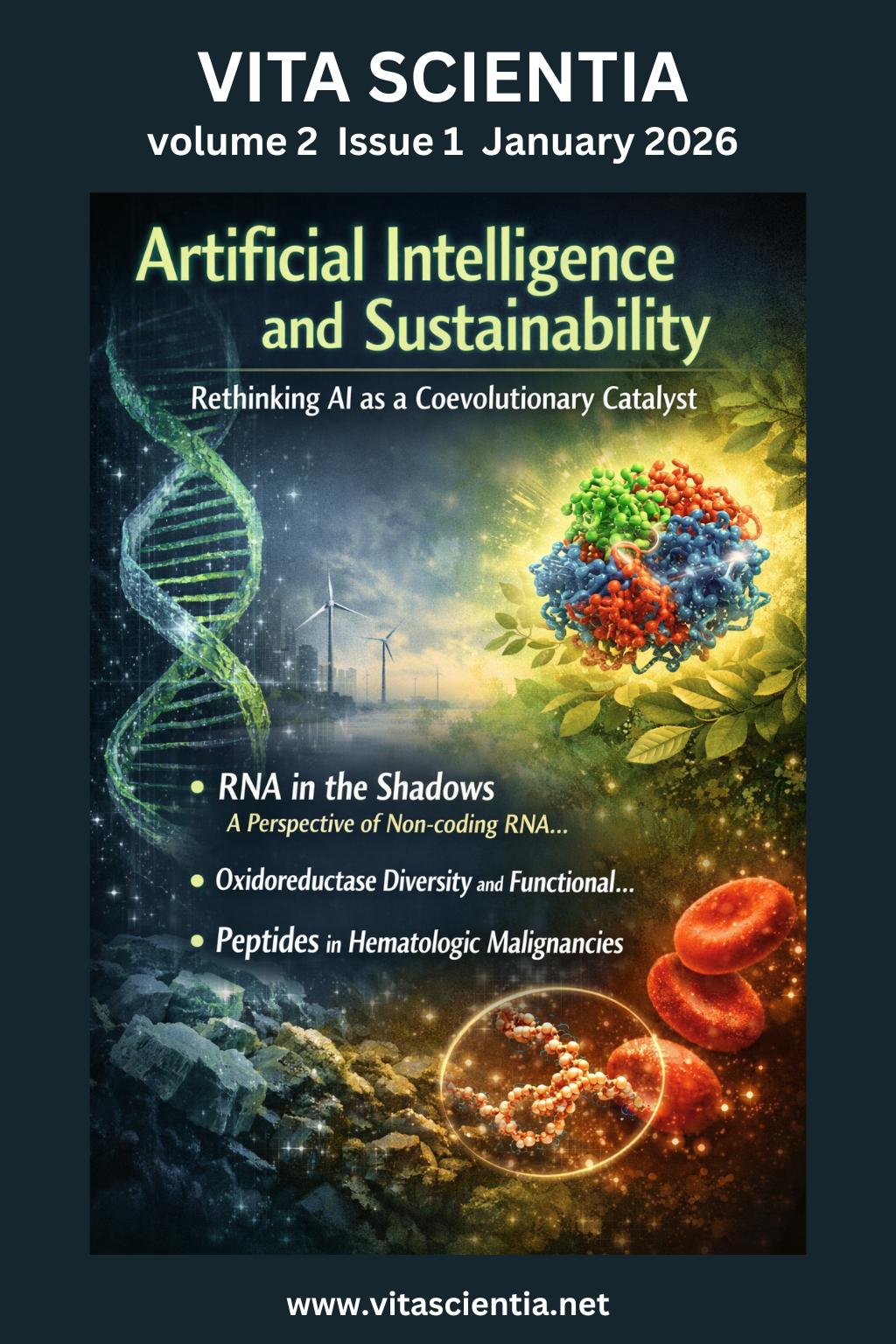
For decades, Artificial Intelligence (AI) was cast as a background tool—an efficient processor of data, a passive observer assisting scientists in making sense of complexity [1]. Sustainability, by contrast, was championed as a fundamentally human pursuit, tied to ethical choices and political will. Yet this dichotomy is now dissolving. Emerging applications suggest that AI is not simply supporting sustainability but coevolving with it, offering dynamic, context-sensitive strategies for navigating the environmental and biological crises of our time.
Artificial Intelligence (AI) plays a major role in the field of sustainability. The interplay between AI and sustainability can be captured through a metaphor: AI as a coevolutionary catalyst. Much like the mutualistic relationships observed in ecosystems, AI and the life sciences are learning from one another, adapting in tandem, and driving forward solutions that neither could achieve in isolation. This reframing invites us to reconsider AI not merely as a computational instrument but as an active partner shaping ecological resilience, agricultural innovation, and planetary health.
From Data to Foresight: AI in Environmental Stewardship
In the early 40”s (1943) the term AI was invented by McCulloch & Pitts and since then AI has reached in this stage developing day by day by the passage of time. Between 1950s- 1970s the foundational theories, logics, between 1980-90s symbolic reasoning like things were happening and from 2000s onwards "experienced rapid advances” and “better algorithm” have been continuing till today. [1] Traditionally, conservation biology relied on painstaking field observations, often limited in scale and scope. Today, AI extends human perception by processing vast, multimodal datasets—satellite imagery, acoustic recordings, drone footage—and translating them into actionable insights. Machine learning models now detect illegal logging, identify species from vocalizations, and predict shifts in biodiversity hotspots under climate change [2,3]. This transition resembles moving from a static map to a dynamic navigation system. While maps depict what is, navigation systems anticipate what will be, continuously recalibrating based on real-time data. Similarly, AI transforms ecological monitoring from retrospective documentation to prospective guidance, empowering conservationists to act before irreversible damage occurs. Yet, as with navigation systems, overreliance on AI carries risks—blind spots in data or biased training sets may misguide decisions, underscoring the need for interpretive human oversight [4].
Precision Agriculture: AI as the “Microscope of the Field”
Drones and sensors feed real-time data into algorithms that recommend targeted irrigation, nutrient management, or pest control [5]. The result is not brute-force intensification but smarter, more efficient farming—yielding more with less environmental cost. These technologies are closely connected to life sciences, linking plant physiology, genetics, and ecology. AI helps predict crop yields by combining genetic and climate data, which could improve how we grow and breed plants. But like a microscope, AI only shows details—it doesn’t explain them. Scientists and farmers still need to understand and interpret the data carefully, keeping nature and ethics in mind.
Smart Cities and Public Health: AI as an Urban Immune System
Urban ecosystems, much like biological organisms, require regulation to maintain homeostasis. Here, AI functions as an urban immune system, monitoring flows of traffic, energy, waste, and pollutants. By adjusting these processes, AI reduces metabolic strain on cities—cutting emissions, conserving energy, and improving air quality [6]. Cleaner air helps reduce breathing problems, better waste management stops the spread of harmful germs, and smart infrastructure makes communities stronger against climate-related challenges. These changes can greatly improve public health. This immunological metaphor also highlights vulnerabilities. Just as autoimmune disorders arise when regulation falters, AI-driven cities risk inequity or dysfunction if algorithms are biased or opaque. In low-resource settings, where infrastructure is fragile, AI could either be a shield that enhances resilience or a stressor that exacerbates disparities [7].
Industry and Manufacturing: AI as the Metabolic Regulator
Industrial production has long been criticized as a driver of ecological imbalance, consuming energy and producing waste with little regard for planetary boundaries. AI introduces the possibility of metabolic regulation within manufacturing systems. Predictive maintenance reduces material waste, defect detection enhances product quality, and supply chain optimization curtails unnecessary resource consumption [8]. AI is like enzymes in a living system—it speeds things up, cuts waste, and keeps balance. But just like enzymes need the right conditions to work, AI also needs clear rules, fair data, and goals that support sustainability. Without these, its power might be used to increase consumption instead of helping the environment.
Ethical Crossroads: The Paradox of AI’s Carbon Footprint
While AI promises sustainability, its own ecological cost cannot be ignored. Training large models consumes vast amounts of energy, generating a carbon footprint that contradicts its green promise [9]. This paradox mirrors the classic dilemma in medicine: treatments that alleviate one condition may inadvertently cause side effects elsewhere in the body. To resolve this tension, the AI community must prioritize “green AI”—models optimized for efficiency without sacrificing performance. Similarly, ethical safeguards must ensure that AI does not entrench inequalities or obscure accountability. In sustainability, as in medicine, interventions must be evaluated holistically, balancing benefits against unintended harms [10].
Toward a Coevolutionary Framework
Taken together, these perspectives suggest that AI in sustainability should not be imagined as a one-way transfer of tools but as a coevolutionary partnership. AI learns from the biological and ecological systems it monitors, while these systems, in turn, are shaped by the decisions AI informs. This reciprocity mirrors coevolutionary dynamics in nature—pollinators and flowers, predators and prey—where both partners adapt in response to one another. Such a framework shifts the question from “How can AI help sustainability?” to “How can AI and the life sciences co-adapt to achieve sustainability?” This reframing acknowledges that AI is not neutral; it encodes human choices, societal priorities, and ecological assumptions. Recognizing this, researchers and policymakers must cultivate AI systems that are transparent, equitable, and energy conscious.
Conclusion
The narrative of AI in sustainability is still unfolding. Early portrayals cast AI as a passive observer, but emerging evidence suggests a more dynamic role: a coevolutionary catalyst capable of reshaping life sciences research and sustainability practices. By conceptualizing AI as a microscope of the field, an urban immune system, or a metabolic regulator, we capture its ability to illuminate hidden patterns, maintain balance, and accelerate change. However, responsible use is crucial to tackle challenges like data privacy and environmental costs of AI itself. When applied ethically, AI accelerates innovation and supports achieving global sustainability goals by enhancing operational efficiency and lowering emissions across sectors.
References
- 1.Press, G. (2016). A very short history of artificial intelligence (AI). Forbes.
- 2.Nishant, R., Kennedy, M., & Corbett, J. (2020). Artificial intelligence for sustainability: Challenges, opportunities, and a research agenda. Int. J. Inf. Manage., 53, 102104. https://doi.org/10.1016/j.ijinfomgt.2020.102104
- 3.Regona, M., Yigitcanlar, T., Hon, C., & Teo, M. (2024). Artificial intelligence and sustainable development goals: Systematic literature review of the construction industry. Sustainable Cities and Society, 108, 105499. https://doi.org/10.1016/j.scs.2024.105499
- 4.Gohr, C., Rodríguez, G., Belomestnykh, S., et al. (2025). Artificial intelligence in sustainable development research. Nat. Sustainability. https://doi.org/10.1038/s41893-025-01598-6
- 5.Fell, A. (2024). Big data comes to dinner: From seed to plate, artificial intelligence is transforming how and what we eat. UC Davis News.
- 6.Sun, T., Wang, Q., & Li, R. (2025). Artificial intelligence–driven green innovation for sustainable development. Energy & Environment. https://doi.org/10.1177/0958305X25934567
- 7.Demeke, C. S. (2025). Exploring the integration of artificial intelligence and sustainability practices in project management. Int. J. Comput. Appl., 186(73), 34–42. https://doi.org/10.5120/ijca2025924600
- 8.Exponentia.ai. AI solutions for industry and manufacturing. Exponentia.ai.
- 9.Strubell, E., Ganesh, A., & McCallum, A. (2019). Energy and policy considerations for deep learning in NLP. ACL, 3645–3650.
- 10.Nishant, R., Kennedy, M., & Corbett, J. (2020). Artificial intelligence for sustainability: A research agenda. Int. J. Inf. Manage., 53, 102104.