
Introduction
The Geopolitics of Agri-Food Systems
Geopolitics has become a major force transforming agri-food systems worldwide, as international tensions have risen [1]. Agri-food
systems refer to the dynamic production, processing, distribution, consumption, and waste management of food, and involve the
interdependence of economic, environmental, and political factors [2]. Geopolitics is a concept that describes the interplay of power
among states over resources, territories, and influence, and is evident in these systems through conflicts, trade issues, and rivalry
over strategic resources [3]. This relationship can be understood through several key mechanisms: (a) trade policies and restrictions
such as tariffs and export bans which affect food availability and prices; (b) control over critical agricultural inputs and natural
resources including land, water, and fertilizers; (c) geopolitical conflicts and sanctions that disrupt production and supply chains;
and (d) infrastructure damage and supply-chain fragmentation caused by political instability. These geopolitical shifts are not merely
theoretical; they produce real disruptions in food supply chains (See Table. 1). For example, due to geopolitical rivalry, competition
over agricultural resources can contribute to international trade, which is crucial to food security, and expose them to politically
instigated disruptions from abroad [4].
Table 1 Geopolitical Shocks and Global Food System Responses (2020-2025)
| Year | Geopolitical / System Shock | Global Agri-Food System Response |
|---|---|---|
| 2020 | COVID-19 pandemic and initial trade restrictions | Disruption of global food supply chains; increased shipping costs and delays |
| 2021 | Pre-war geopolitical tensions and recovery asymmetry | Rising food prices and uneven recovery in import-dependent regions |
| Feb-22 | Russia-Ukraine war begins | Black Sea blockades; >90% drop in Ukraine grain exports initially |
| 2022 | Export bans by >20 countries | Sharp global price spikes; destabilisation of import-dependent countries |
| Mar-22 | Commodity market shock | Wheat futures rise 25% to €396.5/tonne; vegetable oil prices +80% (2020-22) |
| 2022 | Fertiliser supply shock (Russia-Belarus) | Fertiliser prices rise >50%; reduced fertiliser use and yield loss |
| 2022 | FAO Food Price Index peak | FAO Food Price Index increases by 14.3%, highest since 1990 |
| 2023 | Failure of Black Sea Grain Initiative | Led to global supply disruptions and price volatility |
| 2023-2024 | El Niño-linked climate extremes | Crop failures, pest outbreaks, and compounding price volatility |
| 2024 | Global food crisis intensifies | 295.3 million people face acute food insecurity globally |
| 2024 | Conflict-linked famine | Famine declared in Sudan; risks linked to Gaza conflict |
| 2025 (projected) | Rising geopolitical tensions & funding cuts | Food sector funding projected to drop 45%; 14 million children at risk |
| 2025-2026 (projected) | Prolonged geopolitics-climate nexus | Escalation of food insecurity and trade fragmentation |
| 2030 (projected) | Long-term consequence | 582 million people projected to face chronic undernutrition |
How Rising Geopolitical Tensions Are Threatening Global Food Security in 2025-2026?
Increased risks due to the modern geopolitical landscape, with 59 active conflicts in 2023, weaponization of food trade, and
vulnerabilities in import-dependent regions [5]. The editorial is a critical assessment of how geopolitics is redefining agri-food
systems, using verifiable facts based on recent events, including the Russia-Ukraine war and the U.S.-China trade tensions. It
claims that although these forces create instability and inequality, they also reflect the demands for resilience and diversification.
Nevertheless, lacking coherent policy measures, the intersection of geopolitics and climate change may undo decades of progress
toward Sustainable Development Goal 2 (Zero Hunger) and leave 582 million people, 6.8% of the global population, in chronic
undernutrition by 2030 [6, 7].
Weaponization of Food Exports: Export Bans, Price Spikes, and Impacts on Low-Income Countries
Over the course of history, agri-food systems have been intertwined with geopolitics, whether through colonial resource extraction,
soft power via food aid during the Cold War, or similar tactics [8,9]. This entanglement is now exacerbated by globalisation, which
exposes highly interconnected supply chains to shocks. Geopolitical risks hamper supply chains by increasing shipping costs,
redistributing freight, and extending lead times, which usually result in empty shelves and higher prices [10]. To illustrate,
geopolitical events that result in harvest failures can cause a policy reaction, e.g., export bans, which cause price spikes and
political instability. This can be traced in the weaponisation of food exports, where states use agricultural power as a lever to
gain influence, as occurred during Russia's strategic grain deliveries to Africa during the Ukraine conflict. Importantly, those
measures have a disproportionate effect on low-income countries, where dependence on food imports subjects’ populations to exogenous
shocks that continuously amplify the cycle of poverty and instability [11,12].
Geopolitical Risks Reshaping Agri-Food Supply Chains
Geopolitics is redefining agri-food systems by altering trade flows, resource access, and production incentives. States are concerned
with self-sufficiency in a fragmented world, with the environment as a casualty, and MNCs having to navigate trade tariffs and
sanctions. This is guided by increasing geopolitical risks, which are at the top of the executive surveys in the food and agriculture
industry. The war in Ukraine, Red Sea disruptions, and cybersecurity threats are examples that affect US trade policy, which in turn
affects consumer confidence and investment.
Examples of this reframing include trade wars and tariffs. Protectionist measures, including U.S.-China tariffs, cause supply chain
disruption, and China is less dependent on US products since it has to strengthen food security [12,13]. A possible retaliation in the
form of a 60 percent tariff on Chinese imports might escalate the retaliation against US agricultural products and push the world
toward self-sufficiency and diversified sourcing [14]. This opens prospects to emerging markets but undermines US competitiveness.
In the same way, agricultural infrastructure is literally attacked by armed conflict, as in Ukraine [15], where the total loss amounted
to USD 40.2 billion by March 2023, with a further USD 380.5 billion in losses to irrigation infrastructure. This destruction not only
suppresses local production but also spills over into the rest of the world, as fertilizer shortages continue into 2024.
More importantly, these upheavals showcase institutional inequities. It disproportionately affects low- and middle-income countries
that depend on imports from their breadbasket regions, such as Russia and Ukraine (25% of global wheat and barley exports), when those
countries are impacted [16]. Geopolitical tensions increase costs and lead times, leading to food insecurity. For example, export
restrictions after the 2022 war disrupted trade networks, and modularity rose and connectance fell, especially for wheat to Africa
and Asia [17,18]. The countries with upper-middle income lost more than 46.58 million tonnes of wheat imports, and low-income groups
lost 25.59 million tonnes [16]. This example of geographic vulnerability highlights how geopolitics strains the vulnerabilities of
remote countries that rely on imports.
In addition, geopolitics overlaps with other crises, including pandemics and economic volatility, which exacerbate their effects.
For the sixth consecutive year, the 2024 Global Report on Food Crises has reported 295.3 million persons experiencing acute food
insecurity, with conflict (principal in worst crises), climate extremes (e.g., 2023/24 El Niño droughts), and economic shocks
(e.g., inflation) the leading causes of acute food insecurity. There was a displacement of 95.8 million, including 95 percent of
internally displaced persons in countries with food crises. The number of children exposed to a nutrition crisis in 21 countries
was 37.7 million, and pregnant/breastfeeding women were 10.9 million [33]. In 2025, it is projected to be worse due to geopolitical
tensions and funding changes that may see food sector allocations drop by 45 per cent, putting 14 million children at risk [19].
Case Study: Russia-Ukraine War - Impacts on Global Wheat, Grain Supplies, and Fertilizer Markets
The Russia-Ukraine war, which has persisted since February 2022, is an example of the disruptive effects of geopolitics on agri-food
systems [20]. Ukraine, a key exporter of grains, has seen a 29 per cent drop in its output, to 61.8 million tonnes in the 2022/2023
crop, compared to 86.7 million tonnes in 2021/2022; the 2023/2024 crop is expected to drop to 58.8 million tonnes, which is lower
than the 5-year average of 67.68 million tonnes [32]. In early 2022, exports fell by over 90 per cent due to Black Sea blockades,
and by mid-2023, solidarity lanes had moved 90 per cent of pre-war sea exports on land (to 60 per cent). The Black Sea Grain Initiative
helped to export about 27-33 million tonnes of grain, including 8-10 million tonnes of wheat (around 4-5% of global wheat exports).
The initiative collapse in 2023 led to significant supply disruptions, price volatility, and export shortfalls amounting to millions
of tonnes globally [15,33].
The yield loss was sharp: without war losses, the yield of winter cereals fell by 5.42 million tonnes; with a 30% input loss, the yield
fell by 15.04 million tonnes [28]. This was equivalent to 12.89 million tonnes of wheat, 2.09 million tonnes of barley, and 0.07
million tonnes of oats. The total winter cereals lost in regions affected by the war, such as Kharkiv and Donetsk, exceeded 7.68 million
tonnes [16]. Decreases in production were 26 per cent for wheat, 21 per cent for maize, and 32 per cent for soybeans [18]. Projected
exports of Ukraine in 2023/24 are estimated to fall by 10 to 15 million tonnes of wheat and corn, respectively, compared to the 2020/21
level [12].
High price increases characterized the international consequences. In March 2022, wheat futures rose by 25 percent to €396.5 per tonne;
cereals rose by 33 percent, and vegetable oil prices rose by 80 percent between January 2020 and 2022 [21]. In 2022, the FAO Food Price
Index rose by 14.3%, the highest level since 1990 [15]. Prices of fertilisers soared by more than 50 percent, with mono-ammonium
phosphate (MAP) increasing by 53 percent and diammonium phosphate (DAP) by 36 percent between February and April 2022, due to 20
percent of global trade being supplied by Russia/Belarus. This increase led to a decline in fertiliser use and yield, and to a shift
toward crops with lower fertiliser intensity [22].
The situation around food security has become more threatening in the Middle East and North Africa (MENA) and in sub-Saharan Africa,
where Russia and Ukraine provide accounts for about 25-30% of global wheat exports but supply over 40-50% of imports in several
vulnerable regions [21,35]. Undernutrition may increase to one million in MENA and three million in sub-Saharan Africa. By 2030,
the war would have added 119 million people to projections of chronic undernourishment; acute insecurity would have risen by 7.3
million in the Asia-Pacific and 10.5 million in Eastern Africa by June 2022 [15]. In 2024, famine broke out in Sudan, and the risk
was linked to Gaza. More importantly, Russia uses the war to increase its wheat exports, which are projected to rise by 30 to 51
million tonnes in 2023/24 and shift supplies to Africa to influence them [12]. Export prohibitions imposed by more than 20 countries
destabilized distribution channels and led to 75-100 percent cuts in imports in countries like Somalia. This war has caused the one
of the most significant food insecurity in history in relation to the military [16]. Further, the disruption of Ukraine’s
agricultural exports speeded global trade diversification, mainly in oilseed markets. Countries like Brazil and Argentina expanded
their soybean exports, reducing supply gaps created by the decline in Black Sea shipments. China, the world’s largest soybean importer,
increased its reliance on South American suppliers, thereby reducing dependence on traditional sources [34]. There is need for policy
implications focused on trade stability, diversification, and resilience-building in global agri-food systems.
Case Study: US-China Trade Tensions - Effects on Soybean Exports, Diversification, and US Farmer Losses
The case of U.S.-China trade tension can be used to explain how geopolitics can redefine the agri-food trade relations. Since 2018,
the imposition of tariffs has diverted trade, resulting in a loss of 27.2 billion dollars (13.2 billion/year), with China being the
biggest loser (25.7 billion) [23]. Soybeans (71 percent) were the biggest losers; soybean exports dropped by 77 percent, with wheat
(61 percent) and corn (88 percent) following [23]. Export to China fell in January by 6.8 billion dollars (73 percent); soybean exports
plummeted from 985 million bushels (January-May) to 218 million in 2025, with no exports in June or August, and no new crop purchases.
The tariffs will reach 34% in April 2025, making US products uncompetitive, and farmers will lose 5.7 billion dollars in soybean exports
until October 2025[31]. Exports of beef dropped more than 90 per cent since March 2025 because of lapsed licences. Almond tariffs were
45 per cent, which affected 80 per cent of the worldwide almond supply in California. The exports of corn, wheat, or sorghum declined
in 2025, and overall exports were projected to fall to 17 billion US dollars, a 30 per cent decrease from 2024, and further to 9 billion
US dollars by 2026 [24,25].
Any 60% tariff would kill all US oilseed exports to China, with an overall loss of 39 and a 4.2% loss in world oilseed trade. Brazil,
in turn, will be able to address those shortages, as it will be able to export 2.5 billion bushels of soybeans to China in 2025. Such
restructuring is a win for competitors but a heavy burden on US farmers, and rural economies feel the ripple effect [14]. More
importantly, such tensions highlight the risks of dependency. The strategy of diversification in China reduces the United States' market
share, and the strategy of retaliation has been applied to the agricultural market, as it is used as leverage, given surpluses in the
United States. Nebraska, which exports 4.6 percent and loses 5.6 percent in the United States, indicates regional inequalities. Wider
consequences include higher food prices and supply chain exposures, highlighting the role of geopolitics in unequal access to food
worldwide [23]. As China reduced imports from the United States due to tariffs, it expanded its export shares to Brazil and Argentina.
This reduced US market share and increased the risks of reliance on single markets. Hence, the policy implications must be focused on
diversification, reducing dependence on single trading partners, and strengthening resilience in global agri-food systems.
India -US Trade Tensions- Emerging Dynamics in Agricultural Trade Diversification>
Recent trade tensions between India and the United States on agricultural products have shown that geopolitics directly affects agri-
food systems. The disputes on tariffs, market access, and subsidies have forced both countries to consider their dependence on each other.
India started to align with new trade partners and strengthen domestic capacity, while the United States also finds alternative markets
for its farm exports. These shifts reflect a trend where even long-standing partners adjust policies in response to political and
economic pressures. Finally, such changes indicates that the global politics have major effects on the food production, its trade, and
the benefits from these evolving relationships.
The Geopolitics-Climate Nexus: Compounding Threats to Agri-Food Systems and Pathways to Resilience
The extremities of geopolitics and climate change threaten food systems worldwide. Effects of climate, such as floods and droughts,
spread through trade and result in price shocks and instability. By 2022, an extra 100 million people were hungry compared to 2019, and
it is estimated that 582 million people will be undernourished by 2030. This is exacerbated by geopolitical tensions, as seen in Ukraine,
where climate hazards interact with war [11]. Climate change is transforming production, and agri-food systems are the primary sources
of greenhouse gases. Extreme weather disrupts harvests, and geopolitics plays on shortages; e.g., the floods in Pakistan will trigger a
rice shortage in Europe [30]. Droughts and floods associated with El Niño occurred in 2024, causing crop failures and pest outbreaks.
Investment choices are subject to geopolitics, and food insecurity has been turned into a political commodity, as was the case with
Russia's behavior [26]. This nexus expands Sustainable development goals (SDG) achievement amid uncontrolled upheaval in export centers,
more likely under 1.5°C warming. Poor countries are at increased risk due to the urbanisation and population growth exacerbating climate
change. Among the possible mitigation measures are climate-resilient farming, promoting plant-based eating, and minimizing waste [27].
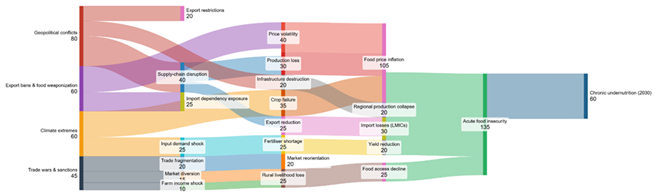
Figure 1 illustrates the transmission of geopolitical conflicts, trade tensions, export bans, and climate extremes through agri-food
systems, resulting in supply-chain disruptions, production losses, and price volatility, ultimately culminating in severe food insecurity.
Climate shocks and trade fragmentation make these pathways stronger by causing crop failures, fertilizer shortages, and less access
to food, especially in areas that rely on imports. The final flow into chronic undernutrition (2030) shows how long-term geopolitical
and climate pressures on global food systems can affect people's health.
Recommendations and Future Implications
Geopolitics also reinstates agri-food systems on a path of fragmentation, where powers like Russia will be advantaged at the expense of
the Global South. Such a relationship promotes inequality, and low-income countries lose 25.59 million tonnes of wheat imports due to
post-ban restrictions [29]. The positive aspects are innovation through diversified sourcing and resilient practices, but this is not
counterbalanced by equitable policy interventions that result in increased risks. The escalating tensions can further exacerbate
undernourishment among millions of people, which, combined with climatic factors, results in a polycrisis. The prescriptions in the
policies should incorporate resilience, with open trade enhanced to reduce the impact of shocks. Geopolitics is permanently
transforming agri-food systems and requires immediate, evidence-based action. Through building resilience and cooperation, the
stakeholders can overcome these challenges to achieve equitable food security.
References
- Fabio GS. Recent trends in agri-food trade and the future in a changing geopolitical environment. Stud Agric Econ. 2025; 127(2):88-96.
- El Bilali H, Strassner C, Ben Hassen T. Sustainable agri-food systems: environment, economy, society, and policy. Sustainability. 2021;13(11):6260.
- Csurgai G. The main components of geopolitical analysis. In: Geopolitics and international relations. 2022. p. 13-61.
- Allouche J. The sustainability and resilience of global water and food systems: Political analysis of the interplay between security, resource scarcity, political systems, and global trade. Food Policy. 2011;36(Suppl 1):S3-8.
- Bhutto SR, Uddin SS, Hussain J. The Architecture of Peace: Rethinking Conflict Resolution in Contemporary International Relations. ASSAJ. 2025;4(02):1929-1939.
- Moramarco S, Buonomo E, Andreoli A, Palombi L. Tackling global malnutrition and Hunger in the final push toward the 2030 agenda. Nutrients. 2025;17(19):3059.
- Zhou J, Dellmuth LM, Adams KM, Neset T-S, von Uexkull N. The geopolitics of food security: Barriers to the Sustainable Development Goal of Zero Hunger. Stockholm: Stockholm International Peace Research Institute (SIPRI); 2020.
- Eddens A. Securitizing the climate crisis: Racial geographies of empire and the agri-fintech frontier. Am Stud. 2021;60(3):63-88.
- Su CW, Dong R, Qin M. Do geopolitical risks impede the global supply chain? Finance Res Lett. 2025;85:107811.
- The Economist Intelligence Unit. Food sustainability and geopolitics [Internet]. London: The Economist Impact; [cited 2026 Jan 20]. Available from: https://impact.economist.com/projects/foodsustainability/blogs/food-sustainability-and-geopolitics
- Rylander Y, Talebian S. Climate change and geopolitical division pose risks to food security, but there are solutions [Internet]. Stockholm: Stockholm Environment Institute & Mistra Geopolitics; 2024 Nov 19 [cited 2026 Jan 21]. Available from: https://www.sei.org/about-sei/press-room/climate-and-geopolitical-division-pose-risks-to-food-security
- Center for Strategic and International Studies. Russia, Ukraine, and global food security: A two-year assessment [Internet]. Washington, DC: CSIS; 2024 Feb 23 [cited 2026 Jan 21]. Available from: https://www.csis.org/analysis/russia-ukraine-and-global-food-security-two-year-assessment
- ING Think. Diverging strategies emerge as geopolitical risks rise in food & agri [Internet]. Amsterdam: ING Group; 2025 Jan 15 [cited 2026 Jan 21]. Available from: https://think.ing.com/articles/diverging-strategies-emerge-as-geopolitical-risks-rise-in-food-agri
- Sivasekari B. Geopolitics & climate: The new reality for agro-food supply chains [Internet]. Beroe Inc.; 2025 Feb 12 [cited 2026 Jan 21]. Available from: https://www.beroeinc.com/resource-centre/insights/agro-food-supply-chains
- Filho WL, Fedoruk M, Paulino Pires Eustachio JH, Barbir J, Lisovska T, Lingos A, et al. How the War in Ukraine Affects Food Security. Foods. 2023;12(21):3996. doi:10.3390/foods12213996
- Jia N, Xia Z, Li Y, Yu X, Wu X, Li Y, et al. The Russia-Ukraine war reduced food production and exports with a disparate geographical impact worldwide. Commun Earth Environ. 2024;5(1):765. doi:10.1038/s43247-024-01915-5
- Dileep M. How geopolitics impacts food supply chains [Internet]. Cropin Insights; 2025 Dec 16 [cited 2026 Jan 21]. Available from: https://www.cropin.com/blogs/geopolitical-shocks-food-supply-chain
- Sarwar D, Rye S. The impact of the Russia-Ukraine war on global supply chains: A systematic literature review. Front Sustain Food Syst. 2025;9:1648918. doi:10.3389/fsufs.2025.1648918
- Global Network Against Food Crises. Global report on food crises 2025 [Internet]. Rome: Food Security Information Network (FSIN); 2025 [cited 2026 Jan 21]. Available from: https://www.fightfoodcrises.net/report/global-report-food-crises-2025
- Council of the European Union. How the Russian invasion of Ukraine has further aggravated the global food crisis [Internet]. Brussels: Consilium; [cited 2026 Jan 21]. Available from: https://www.consilium.europa.eu/en/infographics/how-the-russian-invasion-of-ukraine-has-further-aggravated-the-global-food-crisis
- Glauben T, Svanidze M, Götz L, Prehn S, Jaghdani TJ, Duric I, et al. The war in Ukraine, agricultural trade and risks to global food security. Intereconomics. 2022;57(3):162-167. doi:10.1007/s10272-022-1049-6
- Kee J, Cardell L, Zereyesus YA. Global fertilizer market challenged by Russia's invasion of Ukraine [Internet]. Washington, DC: US Department of Agriculture, Economic Research Service; 2023 Sep 18 [cited 2026 Jan 21]. Available from: https://www.ers.usda.gov/amber-waves/2023/september/global-fertilizer-market-challenged-by-russia-s-invasion-of-ukraine
- McDaniel C. Trade war implications for US agriculture: Round two [Internet]. Lincoln: Yeutter Institute, University of Nebraska-Lincoln; 2025 Mar 12 [cited 2026 Jan 21]. Available from: https://yeutter-institute.unl.edu/research/blogs/trade-war-round-two
- Parum F. Agricultural trade: China steps back from US soybeans [Internet]. Washington, DC: American Farm Bureau Federation, Market Intel; 2025 Oct 2 [cited 2026 Jan 21]. Available from: https://www.fb.org/market-intel/agricultural-trade-china-steps-back-from-u-s-soybeans
- Luck P, Grant-Chapman H, Nguyen DMN. When a trade war becomes a food fight [Internet]. Washington, DC: Center for Strategic and International Studies (CSIS); 2025 Oct 21 [cited 2026 Jan 21]. Available from: https://www.csis.org/analysis/when-trade-war-becomes-food-fight
- University of Pennsylvania. How climate change impacts food security [Internet]. Philadelphia: Penn Today; 2025 Apr 2 [cited 2026 Jan 21]. Available from: https://penntoday.upenn.edu/news/penn-perry-world-house-how-climate-change-impacts-food-security
- Lähde V, Vadén T, Toivanen T, Järvensivu P, Eronen JT. The crises inherent in the success of the global food system. Ecol Soc. 2023;28(4):16. doi:10.5751/ES-14624-280416
- Sheth JN, Uslay C. The geopolitics of supply chains: Assessing the consequences of the Russo-Ukrainian war for B2B relationships. Journal of Business Research. 2023 Nov 1;166:114120. doi: https://doi.org/10.1016/j.jbusres.2023.114120.
- Puma MJ, Bose S, Chon SY, Cook BI. Assessing the evolving fragility of the global food system. Environmental Research Letters. 2015 Feb 1;10(2):024007. doi: 10.1088/1748-9326/10/2/024007.
- Crippa M, Solazzo E, Guizzardi D, Monforti-Ferrario F, Tubiello FN, Leip AJ. Food systems are responsible for a third of global anthropogenic GHG emissions. Nature Food. 2021 Mar;2(3):198-209. doi: https://doi.org/10.1038/s43016-021-00225-9
- Li X. Economic Impact of China's Retaliatory Soybean Tariff on US Soybean Farmers. arXiv preprint arXiv:2503.10715. 2025 Mar 13. doi: https://doi.org/10.48550/arXiv.2503.10715.
- Rose A, Chen Z, Wei D. The economic impacts of Russia–Ukrraine War export disruptions of grain commodities. Applied Economic Perspectives and Policy. 2023 Jun;45(2):645-65. doi: https://doi.org/10.1002/aepp.13351
- Food Security Information Network. Global Report on Food Cises, Joint Analysis for Better Decisions [Internet]. World Food Programme; 2024. Available from: https://www.fightfoodcrises.net/global-report-food-crises
- Poursina D, Aleks Schaefer K, Hilburn S, Johnson T. Economic impacts of the Black Sea grain initiative. Journal of Agricultural Economics. 2024 Feb;75(1):457-64. doi: https://doi.org/10.1111/1477-9552.12549.
- Mottaleb KA, Kruseman G, Snapp S. Potential impacts of Ukraine-Russia armed conflict on global wheat food security: A quantitative exploration. Global Food Security. 2022 Dec 1;35:100659. doi: https://doi.org/10.1016/j.gfs.2022.100659
Acknowledgment
The author sincerely thanks Prof. P. K. Aggarwal, BISA, for a sparking idea on this topic during the lecture delivered on the First Foundation Day of the Division of Environment Science (CESCRA), IARI. The author would like to acknowledge his affiliated institution for providing research facilities and access to literature through ONOS, and his alma mater IARI, New Delhi, India for organizing the foundation day lecture. Author also conveys his thanks to sankeymatic for the resources. Author also acknowledge Ms. Nivaethaa Chandrasekaran for her efforts in bringing this current format.
Funding information
This research did not receive any specific grant from funding agencies in the public, commercial, or not-for-profit sectors.
Credit authorship contribution statement
Govindaraj Kamalam Dinesh: Conceptualisation, Writing - Original Draft, Visualisation
Conflict of Interest
The author declare that they have no conflict of interest. The research was conducted in the absence of any commercial or financial relationships that could be construed as a potential conflict of interest. The manuscript has not been submitted for publication in any other journal.
AI tool usage declaration
During the preparation of this work, the author(s) used Grammarly and Quillbot to correct grammatical errors and improve readability, content flow, and language. After using this tool/service, the authors reviewed and edited the content as needed and take full responsibility for the publication's content.