Summary
Thunbergia fragrans Roxb. (Acanthaceae) is used in Siddha medicine, for the management of various ailments. The present review aims to compile and critically analyse the available information on the phytochemical composition, traditional uses, and pharmacological activities of T. fragrans. Traditionally, the plant has been used to treat stomach disorders, wounds, headache, fever, giddiness, and eye diseases. Phytochemical investigations have reported the presence of phenols, flavonoids, tannins, steroids, alkaloids, and fatty acids. Specific compounds such as hexadecanoic acid, neophytadiene, and linoleic acid derivatives have been identified and are considered to contribute to its biological activities. Pharmacological studies have demonstrated that T. fragrans exhibits diverse therapeutic properties including antioxidant, antimicrobial, antidiabetic, antidiarrhoeal, anti-inflammatory, and anticancer activities. Toxicological studies suggest that the plant is safe at high doses in animal models; however, long-term toxicity and clinical studies are required to confirm its safety and efficacy in humans. This review consolidates the existing knowledge on T. fragrans, highlights current research gaps, and provides a scientific basis for future pharmacological and clinical investigations of this medicinal plant.
Keywords
Antioxidant, Pharmacological activities, Phytochemistry, Thunbergia fragrans, Traditional medicine.
Introduction
India is one of the world’s megadiverse countries and possesses a rich repository of plant biodiversity. It is estimated to have
approximately 45,000 plant species, of which nearly 7,500 are used for medicinal or aromatic purposes. Among these, around 15,000
species are flowering plants, representing nearly 6% of the global angiosperm diversity. Plant-derived materials have been used for
centuries in traditional healthcare systems and continue to serve as valuable resources for the modern pharmaceutical industry. Numerous
therapeutic agents used in contemporary medicine are derived directly or indirectly from plants, emphasizing their significance as
sources of bioactive compounds and their continuing relevance in global healthcare. Therefore, systematic scientific investigation of
medicinal plants is essential to explore their pharmacological potential and identify novel bioactive molecules [1].
One such underexplored plant is Thunbergia fragrans (T. fragrans), a large woody climber belonging to the Acanthaceae family, found in India, Burma, Vietnam, and China, as well as on several islands in the Indian and Pacific Oceans [2,3]. It commonly grows in moist and disturbed habitats, particularly along roadsides, where it is often regarded as a weed [4]. T. fragrans is popularly known as white lady, sweet clock vine, and white thunbergia [5]. In traditional Indian Siddha medicine, the plant is used for the management of several ailments. A paste prepared from tender twigs is applied to the body to reduce fever, leaf juice is used to relieve giddiness, and root juice is used as eye drops. Leaf paste is also applied to wounds and the forehead to alleviate headaches [6].
The present review provides a comprehensive overview of the existing scientific knowledge on the botany, traditional uses, phytochemical constituents, pharmacological activities, and toxicological aspects of T. fragrans. Information was collected from major scientific databases including Scopus, PubMed, and Google Scholar to synthesize the available literature. This review highlights the therapeutic potential of T. fragrans while also identifying important research gaps, particularly the need for detailed toxicological evaluation and well-designed clinical investigations. The findings presented here aim to support future research and promote further scientific exploration of this medicinal plant.
Botanical description and taxonomy
T. fragrans is a fast-growing woody climber characterized by slender, twining stems that can reach up to approximately 3 m in length.
The leaves are oppositely arranged, ovate to triangular in shape, measuring about 6.5–11 cm in length and 1.8–6 cm in width, with
arrow-shaped (sagittate) or occasionally truncate bases and finely toothed to nearly entire margins. The plant bears white, tubular
flowers that appear singly or occasionally in small clusters. Flowering occurs throughout the year in many regions, with peak blooming
typically observed from June to October, while fruiting mainly occurs between August and December. The fruit is a capsule with a
characteristic beak-like tip that dehisces to release globose, pubescent seeds [5].
T. fragrans Figure 1) belongs to the family Acanthaceae, a group of flowering plants characterized by opposite leaves, zygomorphic flowers, and bilocular capsules. The genus Thunbergia was first described by Carl Linnaeus, and later expanded through the work of William Roxburgh, who formally described T. fragrans based on specimens collected from India [7]. Morphologically, T. fragrans is distinguished by its solitary or paired white tubular flowers, opposite ovate leaves with sagittate bases, and beak-shaped fruit capsules that dehisce to release pubescent seeds. These morphological characteristics are typical diagnostic features used to identify species within the genus Thunbergia [5]. The genus includes several species such as T. alata, T. annua, T. battiscombei, T. coccinea, T. cordata, T. erecta, T. elegans, T. fragrans, T. grandiflora, T. gregorii, and T. vogeliana, many of which have been reported to possess diverse biological activities [8].
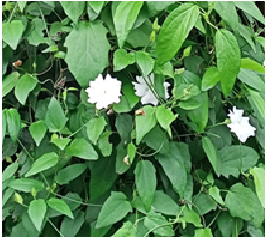
[Source: Author’s photograph].
Over time, several taxonomic synonyms have been associated with T. fragrans due to historical reclassification and varying interpretations of morphological characteristics. These include Thunbergia volubilis Pers., Roxburghia rostrata Russell ex Nees, and Meyenia longiflora Benth [7,8].
History and uses
In traditional Indian Siddha medicine, T. fragrans has been used in several simple remedies for the management of common ailments.
A paste prepared from tender twigs is traditionally applied externally to reduce fever. Leaf juice is sometimes instilled into the nose,
while leaf paste is applied to relieve dizziness and headache. Fresh root juice has also been used externally as eye drops for certain
eye disorders [6]. In addition, a decoction prepared from the leaves is traditionally used to treat stomach-related ailments and fungal
infections [2]. The traditional uses of T. fragrans are summarized in Table 1.
| Sr. No. | Plant Part Used | Traditional Uses |
|---|---|---|
| 1 | Leaves | Leaf paste applied on wounds and forehead to relieve headache; leaf juice used for giddiness (dizziness). |
| 2 | Tender twigs | Paste of tender twigs applied externally to reduce fever. |
| 3 | Roots | Root juice used as eye drops for eye disorders in traditional medicine. |
| 4 | Whole plant | Used traditionally for the treatment of stomach-related ailments. |
Active constituents from T. fragrans have traditionally been extracted using simple preparation methods such as decoction and maceration. Ethnomedicinal reports and literature surveys suggest that the plant has been used in traditional medicine for the management of various conditions, including inflammation, fever, cardiovascular disorders, neurological conditions, skin diseases, diarrhoea, diabetes, giddiness, and headache [2,9,10].
Phytochemistry
Various parts of T. fragrans, including leaves, seeds, and tender twigs, contain several phytochemical constituents that may
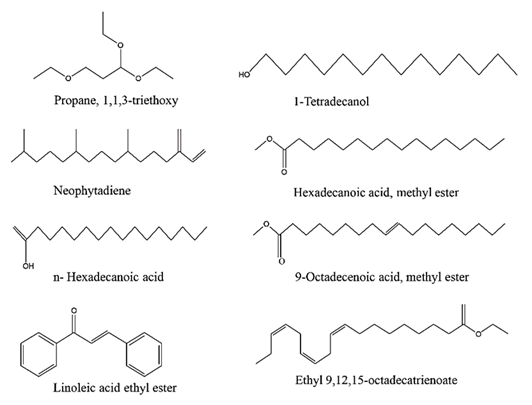
contribute to the biological properties reported for this plant [11]. GC–MS analysis of T. fragrans extracts has identified several
fatty acid derivatives, terpenoids, and alcohols, including neophytadiene, hexadecanoic acid derivatives, and linoleic acid esters
(Table 2 and Figure 2) [5,11]. Fatty acid methyl ester (FAME) analysis of the plant extract revealed that T. fragrans contains
approximately 90.16% unsaturated fatty acids and 9.84% saturated fatty acids, indicating the predominance of unsaturated lipid
components [5].
Further studies are required to isolate and characterize the bioactive compounds present in T. fragrans and to elucidate their mechanisms of action. Such investigations may provide insights into the relationship between chemical constituents and their pharmacological properties, supporting the potential development of this plant as a source of therapeutic agents [12,13].
| Sr. No. | Phytoconstituents |
|---|---|
| 1 | Propane, 1,1,3-triethoxy [13] |
| 2 | 1-Tetradecanol [13] |
| 3 | Neophytadiene [13] |
| 4 | Hexadecanoic acid, methyl ester [13] |
| 5 | n-Hexadecanoic acid [13] |
| 6 | 9-Octadecenoic acid, methyl ester [13] |
| 7 | Linoleic acid ethyl ester [13] |
| 8 | Ethyl 9,12,15-octadecatrienoate [13] |
Pharmacological activities
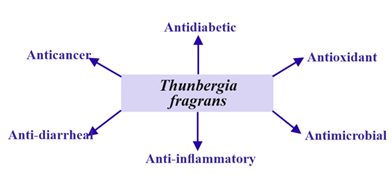
The pharmacological activities of T. fragrans are given in Figure 3.
Antidiabetic
Ethanolic and hydroalcoholic extracts of T. fragrans have demonstrated significant antidiabetic activity in experimental animal models.
In alloxan-induced diabetic rats, oral administration of the extracts at doses of 150–400 mg/kg body weight resulted in a reduction in
blood glucose levels ranging from 21.8% to 35% after two to four weeks of treatment. In addition, improvements in body weight and white
blood cell count were observed, suggesting an overall improvement in diabetic symptoms [14].
The extracts also improved biochemical markers associated with liver and kidney function and enhanced antioxidant enzyme activities such as superoxide dismutase (SOD), glutathione peroxidase (GPx), catalase, and reduced glutathione (GSH), indicating protection against oxidative stress. Furthermore, normalization of hepatic glycogen levels and preservation of the histological structure of the pancreatic islets of Langerhans were reported, suggesting protective effects on pancreatic β-cells [14].
The antidiabetic activity of T. fragrans is likely associated with the presence of bioactive phytochemicals such as flavonoids, chlorogenic acid, and alkaloids, which may enhance insulin secretion and improve peripheral glucose utilization. Importantly, the extracts did not produce significant toxic or adverse hematological effects in experimental animals, indicating a favorable safety profile in these studies [14].
Antioxidant
Extracts of T. fragrans contain several bioactive phytochemicals that contribute to its antioxidant potential. In vitro studies have
shown that ethanolic leaf extracts exhibit significant and dose-dependent free-radical scavenging activity against DPPH radicals.
Phytochemical screening indicates the presence of flavonoids, phenolic compounds, and other antioxidant constituents that may be
responsible for this activity. Fourier transform infrared (FTIR) analysis has further revealed functional groups corresponding to
alkenes, alcohols, aromatic compounds, aliphatic amines, and alkanes, suggesting the presence of diverse bioactive molecules within
the extract. These phytochemicals may contribute to the neutralization of reactive oxygen species and help protect biological systems
from oxidative stress associated with various pathological conditions. Overall, the antioxidant activity of T. fragrans supports its
potential as a natural source of therapeutic agents [11].
Antimicrobial
Leaf extracts of Thunbergia fragrans have demonstrated notable antimicrobial activity against several pathogenic microorganisms. Both
alcoholic (ethanolic and methanolic) and aqueous extracts have shown inhibitory effects against bacterial strains such as Staphylococcus
aureus and Escherichia coli. The observed antimicrobial activity is attributed to the presence of bioactive phytochemicals capable of
disrupting microbial cell membranes and interfering with essential metabolic processes. In certain studies, the inhibition exhibited by
the plant extracts was comparable to that of standard antimicrobial agents such as streptomycin [6]. These findings support the
traditional medicinal use of T. fragrans and highlight its potential as a source of natural antimicrobial compounds [4].
Anti-inflammatory
Phytochemical analysis of T. fragrans extracts collectively contributes to its significant anti-inflammatory activity. Traditional
Indian Siddha medicine utilizes the T. fragrans for treating open wounds, and occasionally, leaf paste is applied on the forehead to
reduce headaches, indicating its utility in inflammation-related conditions. Scientific studies show that these phytoconstituents can
help suppress the inflammatory pathways. These effects are due to their antioxidant properties and modulation of pro-inflammatory
mediators. However, despite promising preliminary evidence, further in-depth studies, including in vivo and clinical investigations,
are necessary to confirm and clarify the exact anti-inflammatory mechanisms and therapeutic efficacy of T. fragrans extracts [12].
Antidiarrheal
The acetonic and ethanolic leaf extracts of T. fragrans have demonstrated significant antidiarrhoeal activity in Swiss albino mice at
an oral dose of 500 mg/kg body weight. The activity was evaluated using the charcoal meal test and the castor oil-induced diarrhoea model.
Both extracts significantly reduced gastrointestinal motility, as evidenced by the decreased distance travelled by the charcoal meal
through the intestine. The inhibition percentages were 55.51% for the acetonic extract and 59.34% for the ethanolic extract, compared
with 48.92% for the standard drug loperamide. In the castor oil-induced diarrhoea model, both extracts provided complete protection
(100%) against diarrhoea, comparable to loperamide. The observed antidiarrhoeal activity may be attributed to the presence of tannins,
which are known to exert an astringent effect on the intestinal mucosa and reduce intestinal motility and secretion. These findings
support the traditional use of T. fragrans in the management of diarrhoeal disorders. However, further studies are required to isolate
the active constituents and clarify their mechanisms of action [2].
Anticancer
Studies have reported that the ethanolic extract of T. fragrans leaves exhibits cytotoxic activity against cancer cell lines such as
A549 (lung carcinoma) and SiHa (cervical cancer). Cytotoxicity assays have demonstrated moderate antiproliferative activity with EC₅₀
values of approximately 81.31 µg/mL for A549 cells and 91.51 µg/mL for SiHa cells. The extract contains various bioactive
phytoconstituents, including phenolic compounds and flavonoids, which may contribute to the observed cytotoxic effects. These compounds
are believed to interfere with cellular signaling pathways involved in cancer cell proliferation and survival, thereby inhibiting tumour
growth. Additionally, treatment with the extract has been associated with morphological changes in cancer cells, suggesting potential
apoptotic or growth-inhibitory effects. Although these findings indicate promising anticancer potential, further investigations,
including detailed mechanistic studies and in vivo evaluations, are necessary to validate the therapeutic potential of T. fragrans
extracts in cancer treatment [15].
Toxicity studies
Toxicological investigations on T. fragrans are limited but suggest relatively low acute toxicity. Acute oral toxicity studies conducted
in Swiss albino mice have shown that ethanolic and acetone leaf extracts are well tolerated at doses up to 2000 mg/kg body weight, with
no observed mortality or significant behavioural changes. These findings indicate that the LD₅₀ value is greater than 2000 mg/kg body
weight, suggesting a relatively wide safety margin for acute exposure. Although these results indicate a favourable safety profile,
comprehensive toxicological data are still lacking. Further investigations, including sub-chronic and chronic toxicity, mutagenicity,
genotoxicity, teratogenicity, and pharmacokinetic studies, should be conducted according to standardized OECD guidelines to establish
the long-term safety of the plant. Traditional use of T. fragrans for the treatment of wounds, fever, and gastrointestinal disorders has
not reported significant adverse effects; however, such empirical evidence cannot substitute for systematic scientific evaluation.
Therefore, detailed toxicological assessments, including repeated-dose toxicity and reproductive toxicity studies, are required to
better define the long-term safety profile, potential risks, dosage parameters, and therapeutic window of T. fragrans preparations [2].
Future perspectives
Future research on T. fragrans should focus on identifying and characterizing its bioactive constituents through bioassay-guided
fractionation and structural elucidation. Standardization of plant extracts and evaluation of their dose–response relationships are
also necessary to ensure reproducibility and therapeutic reliability.
Further investigations should explore the molecular mechanisms underlying the reported pharmacological activities, including studies on relevant cell signaling pathways, enzyme inhibition, and gene expression. Comprehensive toxicological evaluations, including chronic toxicity, reproductive toxicity, and pharmacokinetic studies, are required to establish long-term safety. In addition, well-designed preclinical and clinical studies are needed to confirm the therapeutic efficacy of T. fragrans preparations in humans. The application of modern research approaches such as metabolomics, proteomics, and advanced drug-delivery systems may further support the development of standardized and evidence-based herbal formulations derived from this plant. Such investigations could strengthen the scientific validation and potential therapeutic utilization of T. fragrans.
Conclusion
Recent developments in cosmetic science have greatly improved the effectiveness, safety, and sensory qualities of lipstick products. New technologies in nanoscale delivery systems have enhanced pigment stability, moisturizing effectiveness, and the controlled release of bioactive ingredients, resulting in improved wear and greater consumer satisfaction.[29]
Acknowledgment
We acknowledge Dr. Niranjan S. Mahajan, Principal, Adarsh College of Pharmacy, Vita, for providing the necessary facilities and a conducive environment to carry out this work. Authorship statement: All authors contributed equally.
Conflict of interest statement
Not applicable
References
- Pandey A, Negi PS. Traditional uses, phytochemistry and pharmacological properties of Neolamarckia cadamba: A review. J Ethnopharmacol 2016;181:118–35. https://doi.org/10.1016/j.jep.2016.01.036.
- Sheshadri Shekhar D, Ashok Kumar BS, Suresh N, Dhanasekaran S. Evaluation of antidiarrhoeal activity of Thunbergia fragrans roxb. Asian J Chem 2007;19:2792–6.
- Tseng Y-H, Ou C-H. Thunbergia fragrans Roxb. (Acanthaceae) A newly naturalized plant in Taiwan. Endem Species Res 2002;4:59–62.
- Baratam K, Boddu V. Evaluation of phytochemical and antibacterial activity of thunbergia fragrans. Asian J Green Chem 2025;9:476–93. https://doi.org/10.48309/AJGC.2025.508571.1695.
- Payamalle S, Shinde S, Joseph KS, Mutakekar S, Murgude M, Tawadare R, et al. Chemical properties and fatty acid composition of Thunbergia fragrans Roxb. seed oil. J Am Oil Chem Soc 2016;93:295–7. https://doi.org/10.1007/s11746-015-2767-4.
- Kumar MR, Aishwarya BM, Balu H, Ranjith S, Chandan K, Bharathi D, et al. Evaluation of antimicrobial activity of hydro-alcoholic extract of thunbergia fragrans. UPI J Pharm Med Heal Sci 2022;5:56–62. https://doi.org/10.37022/jpmhs.v5i3.79.
- Kiew R, Vollesen K. Asystasia (Acanthaceae) in Malaysia. Kew Bull 1997;52:965. https://doi.org/10.2307/4117823.
- Kumar PY, Subramaneyaan M. Phytochemical evaluation and pharmacological activities of Thunbergia species - A comprehensive review. Int J Biol Pharm Allied Sci 2021;10:233–43.
- De Cássia da Silveira e Sá R, Andrade L, De Sousa D. A review on anti-inflammatory activity of monoterpenes. Molecules 2013;18:1227–54. https://doi.org/10.3390/molecules18011227.
- Vincent S, Padavattan N, Subramani S, Rjapandi MJ, Prathapavarma D, Kumar K, et al. Pharmacological toxicities and antidiarrhoeal activity of thunbergia. J Gujarat Res Soc 2016;21:160–72. https://doi.org/10.22205/sijbs/2016/v2/i3/100305.
- Kumar PY, Kumar A, S M, Mohan V. Antioxidant and antiproliferative activity of Thunbergia fragrans plant extracts, fucoidan and both mixture against hela cervical cancer cell lines. African J Biomed Res 2024;27:8402–10. https://doi.org/10.53555/AJBR.v27i4S.3177.
- Kumar MR, Aishwarya BM, Hrishikesh B, Ranjith S, Chandan K, Bharathi DR, et al. Evaluation of antimicrobial activity of hydro-alcoholic extract of thunbergia fragrans. UPI J Pharm Med Heal Sci 2022;5:56–62. https://doi.org/10.37022/jpmhs.v5i3.79.
- Chandrasekaran C, Karuppiah R. Evaluation of the antioxidant and antimicrobial Activity of Thunbergia fragrans Roxb leaves extract. J Nat Remedies 2022;22:33–42. https://doi.org/10.18311/jnr/2022/27275.
- Nallamuthu P, Sundaresan S, Jeyarani RM, Vincent S. Toxicity effects on anti--diabetic activities of T. fragrans in wistar albino rats. World J Pharm Pharm Sci 2019;8:1020–64. https://doi.org/10.20959/wjpps201912-15190.
- Nallamuthu P, Sundaresan S, Jeyarani R, Vincent S. Cytotoxicity effects on cervical cancer and lung cancer cell Lines oF Thunbergia fragrans. A J Compos Theory 2019;XII:736–49.